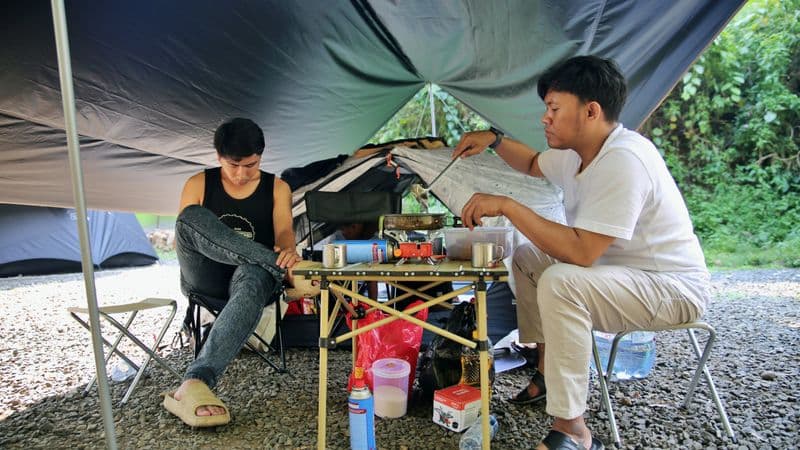

A car camping stove gets to ignore the rule that dominates every other piece of camp gear: weight. Since the trunk does the carrying, the best camping stove for car camping 2026 is simply the one that cooks best — real burner power, a flame that turns down low enough to not scorch pancakes, and wind panels that keep dinner on schedule when the breeze picks up. Here are the three two-burner stoves worth hauling, the propane setup that saves real money, and the calendar windows when stove prices actually drop.
What actually matters in a car camping stove
Two-burner propane suitcases all look alike on the shelf, but four things separate the stove you love from the one that ruins dinner. First, burner power: BTU ratings measure maximum heat output, and while 10,000 BTUs per burner handles most camp cooking, 20,000-BTU burners boil big pots dramatically faster and hold their own in wind. Second — and more overlooked — is simmer control. Cheap valves jump from roaring to off with nothing usable in between; a good needle valve lets you hold rice at a bare bubble.
Third, wind resistance. The lid and fold-out side panels form a three-sided shield, and stoves differ meaningfully in how well those panels seal around the burners — wind is the number-one thing owners blame for slow boils. Fourth, the propane setup: every stove here screws onto a disposable 1-pound canister, but the models with a decent regulator also run happily off a 20-pound bulk tank with a cheap hose, which is how frequent campers should run them.
The best camping stove for car camping 2026: three picks compared
These three cover the realistic budgets: a do-everything flagship, a $60 classic, and a specialist for people who actually cook. All three are propane two-burners that fold into a suitcase — the format that has dominated car camping for good reason.
Best overall: Camp Chef Everest 2X
The Everest 2X is the stove that gets recommended when someone asks what to buy without a budget cap, and the owner consensus explains why: two 20,000-BTU burners — double the Coleman's output — paired with valves fine enough to take a pot from rolling boil to gentle simmer without relighting. A matchless push-button igniter, a latching lid, and a regulator that keeps pressure steady on chilly mornings round out the package. At roughly twelve pounds it's still an easy one-hand carry. The compromises are price — street pricing usually lands between $180 and $200 — and the igniter, which owners report can get temperamental after a few seasons (a lighter fixes that). If you cook real meals for a group, this is the one.
Best value: Coleman Cascade Classic Stove
The Cascade Classic is the current name for the green Coleman suitcase stove that has been feeding campgrounds for generations, and its case is simple: around $60, two 10,000-BTU burners, fold-out wind panels, and a build that owners routinely describe outliving tents, coolers, and vehicles. It boils a morning kettle and cooks a skillet dinner for two or three without complaint, and replacement parts are everywhere. The trade-offs are exactly what the price implies: there's no igniter, so you light it with a match or lighter, and the low end of the valve is coarse — delicate simmering takes fiddling and a windless evening. As a first stove or a buy-it-once backup, nothing else touches it.
Best simmer control: Eureka Ignite Plus
The Ignite Plus is the pick for camp cooks who care more about how a stove cooks than how fast it boils. Its two 10,000-BTU burners have the best turn-down in the category — owners consistently call out how steadily it holds a low flame, which is what you want for pancakes, eggs, and sauces that scorch on coarser stoves. The cooking deck is the other headline: at about 23 inches wide it genuinely fits two 12-inch pans side by side, which most two-burners only claim. A push-button igniter and simple, solid latches complete it, typically for $10–30 more than the Coleman. The honest knock is peak power — half the Everest's output means big pots of pasta water take patience, especially in wind.
Propane and accessories worth adding
The green 1-pound propane bottles are convenient and quietly expensive — $5–8 each for about an hour and a half of two-burner cooking, and they're a headache to dispose of properly. The fix costs less than a tank of gas: a bulk-tank adapter hose connects any of these stoves to a standard 20-pound grill tank, which refills for roughly the price of four disposables while holding twenty times the fuel. Refillable 1-pound cylinders are a middle path if you want to keep the compact format.
Beyond fuel, keep the accessory list short: a folding stove stand if your campsites don't have tables, a compact windscreen for exposed sites, and a griddle plate — Camp Chef and Eureka both size their decks with one in mind.
Buy the hose before the second trip
Never cook inside a tent
When camp stoves are cheapest
Camp stoves shadow the grill clearance calendar, not the electronics one. Retailers stock up for spring, hold prices through peak summer, and then clear seasonal inventory starting at Labor Day — which makes September through early fall the reliable window, with typical savings of 20–30% off spring pricing. Black Friday brings a second dip, often the year's best on Camp Chef bundles. Prime Day in July moves Coleman pricing but rarely the premium brands. These are typical historical patterns, not guarantees — but if you can cook on your old stove until September, the discount is usually waiting.
| Window | Typical move | Verdict |
|---|---|---|
| Spring (March–May) | Full price as camping season ramps up | Wait |
| Prime Day (July) | 15–25% off Coleman and Amazon-native brands | Maybe |
| Labor Day–early fall | 20–30% off as seasonal stock clears | Buy |
| Black Friday / Cyber Monday | 20–30%, best on Camp Chef bundles | Best |
| Winter (Dec–Feb) | Thin stock, occasional clearance leftovers | Maybe |
- Typical move
- Full price as camping season ramps up
- Verdict
- Wait
- Typical move
- 15–25% off Coleman and Amazon-native brands
- Verdict
- Maybe
- Typical move
- 20–30% off as seasonal stock clears
- Verdict
- Buy
- Typical move
- 20–30%, best on Camp Chef bundles
- Verdict
- Best
- Typical move
- Thin stock, occasional clearance leftovers
- Verdict
- Maybe
Ranges reflect typical historical retail patterns on two-burner propane stoves. Individual deals vary.
The verdict
The Camp Chef Everest 2X is the best camping stove for car camping in 2026 — the only pick here that delivers restaurant-burner power and real simmer control in one suitcase. The Coleman Cascade Classic remains the value answer for anyone whose camp menu is coffee and one-pan dinners, and the Eureka Ignite Plus is the quiet favorite for people who actually enjoy cooking outside. Whichever you choose, add the bulk-tank hose and time the purchase for the fall clearance window if you can wait.
For the full seasonal picture, our guide to when camping gear goes on sale maps every category month by month, and since stoves track grill pricing so closely, when grills go on clearance is worth a read before you buy. Shopping the end-of-summer window specifically? Our Labor Day outdoor gear sales 2026 preview covers what to expect.